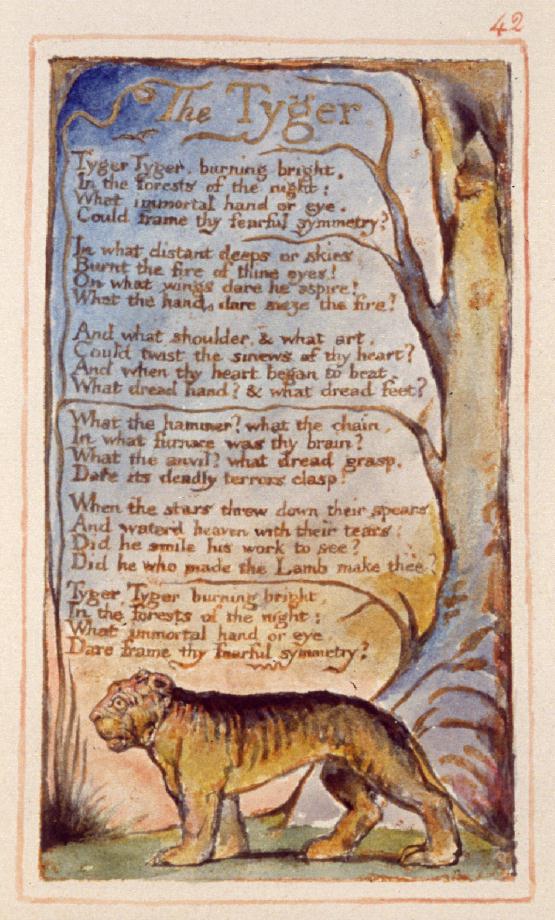
The Tyger – William Blake

The Tyger is a poem by William Blake, a English poet, painter and print maker. Blake’s works are considered seminal in poetry and visual arts. This is part of the book called The Songs of Experience published in 1794. It is one of Blake’s most known and analysed poems. Many of the facsimile prints can be seen here.

 
In the original print the poem is illustrated.

Tyger Tyger, burning bright,
In the forests of the night :
What immortal hand or eye,
Could frame thy fearful symmetry?
In what distant deeps or skies
Burnt the fire of thine eyes?
On what wings dare he aspire?
What the hand dare seize the fire?
And what shoulder, & what art,
Could twist the sinews of thy heart?
And when thy heart began to beat,
What dread hand? & what dread feet?
What the hammer? what the chain,
In what furnace was thy brain?
What the anvil? what dread grasp
Dare its deadly terrors clasp?
When the stars threw down their spears
And water’d heaven with their tears :
Did he smile his work to see?
Did he who made the Lamb make thee?
Tyger, Tyger burning bright
In the forests of the night :
What immortal hand or eye
Dare frame thy fearful symmetry?


I first read this poem in the Rendezvous With Rama series by Arthur C. Clarke and Gentry Lee. In the book one of the characters is overwhemled by the appeareance of the giant space-ship named Rama and in wonder says the lines from Blake’s Tyger.
As a species tiger is seriously endangered and its survival depends on just a few thousand (~ 1.5 K) indivduals left in the wild. They say that if immediately steps are not taken, we might not see the tiger in wild beyond the second decade of the century. Illegal poaching and destruction of the habitat are mainly responsible for exponential decline in the tiger population in the country.

Humble hovel or Palace

How slowly one advances in a boat that does not float along with the stream in a specific direction! How much easier it is when one can connect with the work of great predecessors whose value is not doubted by anyone. A personal experiment, a construction whose foundations one must dig himself and whose walls one must erect himself, runs a real risk of becoming a humble hovel. But perhaps one prefers to live there rather than in a palace that has been built by others.
M. C. Escher | Escher on Escher – Exploring the Infinite

Most of us would have already made the choice. For me the choice is somewhat both maybe the garden of the palace and living space of the hovel. I may try to give up the palace garden sometime in the future but for now it is so. What about you?

Kafka and Orwell


Two of my favourite authors. Both of them were from almost same era, early part of 20th century. Both of them wrote about bureaucracy, corruption, control, power, and helplessness of individuals in the greater scheme of things. Reading them a dark feeling covers your soul, and all chances of redemption appear bleak. We are, it seems, doomed for life, and only non-existence in to oblivion or death can relieve us of these torments, as it does to many characters of this duo.
The things that are happening now around us, the FUDs and stereotyping of “The Enemy” reminds one much of the situation in Nineteen Eight Four. Maybe the policy makers grew up reading Nineteen Eight Four and found enough material to be implemented in the real world. Or as it happens in The Castle, one can easily identify with the main protagonist whose life is made into an unending sequence of visits to the offices in The Castle. As it happens during visits to most of the government offices.

Places, Pictures and People

I like to have pictures of interesting and beautiful places I have been, but it seems unnecessary for me to appear in these pictures, and I have never quite understood why other people want that so much.

via Tikal | RMS
Frankly, I could not agree more. It is more like people want to tell you that I have been there. But in case of nutcases they will make sure that every photo that they take, of the monuments and the cityscapes that they went to, will have themselves as part of the photo. This is narcissism at its best. You want to tell the world that “I was there.” How many social-networking pages/posts are flooded with images of monuments with the poster / people as soon as they visit them? Better still live posting! In an earlier era of non-social networking, people used more cruder methods to tell you this. The solution was simple, just put your name on the monument, to tell all others you were there, or that you own the monument. Not that it is a bad thing, but at times it takes away all the beauty of the place under question to limits of what can be considered to be decent.  But this just seems to be just one more human tendencies, which I am not able to relate to, which would be because may be I am becoming de-humanized.

On another note, even kings and emperors could not give up this temptation. Apparently after conquering the Adilshahi kingdom of Bijapur, the last Great Mughal Aurangazeb, made an inscirption on the Malik-e-Maidan cannon (This cannon second largest, single cast canon). Though more artfully made, it is of the same kind.

On-line Education | RMS

Educators, and all those who wish to contribute to on-line educational works: please do not to let your work be made non-free. Offer your assistance and text to educational works that carry free/libre licenses, preferably copyleft licenses so that all versions of the work must respect teachers’ and students’ freedom. Then invite educational activities to use and redistribute these works on that freedom-respecting basis, if they will. Together we can make education a domain of freedom.

via On-line Education|RMS
Mostly people don’t bother about what they get for gratis on the Internet, but institutions cannot adopt the same approach. Licensing is as much important as much as the actual content. But an archaic system will not go down till it is compelled to, and it will fight till the very end.

Wikipedia | New Politics Of Knowledge

Professionals are no longer needed for the bare purpose of the mass distribution of information and the shaping of opinion. The hegemony of the professional in determining our background knowledge is disappearing—a deeply profound truth that not everyone has fully absorbed.
In their view, Wikipedia represents the democratization of knowledge itself, on a global scale, something possible for the first time in human history.
As wonderful as it might be that the hegemony of professionals over knowledge is lessening, there is a downside: our grasp of and respect for reliable information suffers.  With the rejection of professionalism has come a widespread rejection of expertise—of the proper role in society of people who make it their life’s work to know stuff.
For instance, journalists, interviewers, and conference organizers—people trying to gather an audience, in other words—use “expert” to mean “a person we can pass off as someone who can speak with some authority on a subject.”  Also, we say the “local expert” on a subject is the person who knows most, among those in a group, about the subject.  Neither of these are the very interesting senses of “expert.”
To exclude the public is to put readers at the mercy of wrongheaded intellectual fads; and to exclude experts, or to fail to give them a special role in an encyclopedia project, is to risk getting expert opinion wrong.
If we reject the use of credentials, we reject all evidence of expertise; ergo, lacking any means of establishing who is an expert, we reject expertise itself.  Meritocrats are necessarily expert-lovers.
Experts know particular topics particularly well.  By paying closer attention to experts, we improve our chances of getting the truth; by ignoring them, we throw our chances to the wind.  Thus, if we reduce experts to the level of the rest of us, even when they speak about their areas of knowledge, we reduce society’s collective grasp of the truth.

via On The New Politics Of Knowledge | Conversation | Edge
On the brighter side of it, we are for the first time able to participate in many things. Just being trained in a discipline (PhD?) does not automatically create opportunities for one in the old system. But in Wikipedia it does. How many people who have PhD do get an opportunity to write a text-book or a popular article? I would like to ask how many of contributors on Wikipedia are really subject experts? There might be many, and they would be able to point at the right evidence, when needed to “show off” their authority in the field, which the normal user won’t be. So what’s the fuss about?


Orwell On Books…

In two of his essays Books vs. Cigarretes and Bookshop Memories George Orwell tells us what he thinks about books. Me being a bibliophile could relate to many things he said.
He says out of the 900 odd books he has, around 500 are bought second-hand. While most of mine are second hand.

The idea that the buying, or even the reading, of books is an expensive hobby and beyond the reach of the average person is so  widespread that it deserves some detailed examination.

Even now I know of people who get and give weird reactions to the sight of books, as if they are something ugly and avoidable.

This is because book-giving, book-borrowing and book-stealing more or less even out.

Well may be in the long run it is indeed true. I have lost many books, but there are may be more with me which belong to others, but which I did not steal. But many just ended up being with me.

It is difficult to establish any relationship between the price of books and the value one gets out of them. “Books” includes novels, poetry, text books, works of reference, sociological treatises and much else, and length and price do not correspond to one another, especially if one habitually buys books second-hand. You may spend ten shillings on a poem of 500 lines, and you may spend sixpence on a dictionary which you consult at odd moments over a period of twenty years. There are books that one reads over and over again, books that become part of the furniture of one’s mind and alter one’s whole attitude to life, books that one dips into but never reads through, books that one reads at a single sitting and forgets a week later: and the cost, in terms of money, may be the same in each case. But if one regards reading simply as a recreation, like going to the pictures, then it is possible to make a rough estimate of what it costs.

Here I see an analogy between books and humans (or is it the other way round?). Just as he describes different types of books, some of which we just dip into, some we savour for our lives, some we just refer maybe once in a while, so are our human contacts, some are just hi-bye types, some we share our intimate moments with, some we just meet once in our lives, but they are unforgettable, some we just forget, and others we want to forget. Seen in this way at another level, books are just ideas that are present in them, so are the humans we come in contact with (though at times the physical intimacy is better, (but isn’t physical intimacy also an idea)). Some people we make our heroes, some books give us our philosophy of life. Some people give us sound advice, many books save us from despair. Books are actually people who talk to us, make us experience things we would otherwise not experience, isn’t the same true of people also. But of course there are crap books and there are crap people.

If you concentrated on more serious books, and still bought everything that you read, your expenses would be about the same. The books would cost more but they would take longer to read. In either case you would still possess the books after you had read them, and they would be saleable at about a third of their purchase price. If you bought only second-hand books, your reading expenses would, of course, be much less: perhaps sixpence an hour would be a fair estimate.

I never sold my books, and hopefully will never need to.

And if our book consumption remains as low as it has been, at least let us admit that it is because reading is a less
pastime than going to the dogs, the pictures or the pub, and not  because books, whether bought or borrowed, are too expensive.

And he ends Bookshop Memories thus

But as soon as I went to work in the bookshop I stopped buying books. Seen in the mass, five or ten thousand at a time, books were boring and even slightly sickening. Nowadays I do buy one occasionally, but only if it is a book that I want to read and can’t borrow, and I never buy junk. The sweet smell of decaying paper appeals to me no longer. It is too closely associated in my mind with paranoiac customers and dead bluebottles.

I hope I do not end up doing the same. For now I think I am maybe making a transition from bibliophilia to bibliomania.
For a comprehensive list of Orwell’s works see: http://orwell.ru


Freedom of Expression in India

This is a meta blog, as it is a blog about this blog.
About 10 years back the GoI decided that there were a lot of dissident voices from the North-East on Yahoo! Groups which were harmful to the health of the nation. The result was that there was a blanket ban on Yahoo! groups. Then people who were using Yahoo! Groups other than what GoI thought was harmful, suffered too. It was a classic case of complete misunderstanding about the nature of how the internet works. Of course then as now people had means to go over the blockade. That was 10 years back, net penetration was not that much, so we could forgive the bureaucracy over such things. Claiming disease called ignorance.
10 years have passed, one would have expected that the babus and their political masters would have learned (something) about how this new technology works and how it is fundamentally different than other mass media. If not the old babus, the somewhat younger generation which replaced them. (Oh, but I heard babus never retire they are kept on the job as part of this or that committee.) In a sense of deja vu, this time also the trouble was in the North-East. After the violence there, and its strange aftermath in Bombay (Middle-West) thousands of kilometers away and also in Bangalore (Down-South). Then began the blame games and it was discovered that the social networking sites were the culprit. So what is the quick fix solution? Ban all of them.

ना रहेगा बास ना बजेगी बांसुरी .

So this blog and my other blogs were not accessible through my humble Photon+ conncetion. It just refused to open these sites. I thought it was some problem with my connection. Only today I came to know the grim reality, that they had actually blocked WordPress, completely! Though other ISPs as of now have not, but it may not be long before they do that. This is akin to banning all printing presses as someone prints something objectionable to someone. And in a democracy, someone will get offended by whatever you say. But it might be just that the babus are also executing their freedom of speech, by giving orders to ISPs for blocking other people’s Freedom of Speech. Here we are in paradoxical situation.

Can Freedom of Speech of one person supersede the Freedom of Speech of other? But the constitution says that all people are equal, then how is this possible?

Orwell comes to our rescue then when says:

All are equal and some are more equal than others.

This cuts the knot for us, and we can perfectly make sense of the things that are happening around us.
Maybe someone needs to  put up a PIL in SC against such blanket bans in the future, to uphold the Right to Free Speech! And I sincerely hope that person who makes such a PIL is more equal than others.
And may be not all of you will be able to read this, as wordpress is blocked…

The PhD Octopus

Thus, we at Harvard are proud of the number of candidates whom we reject, and of
the inability of men who are not distingues in intellect to pass our tests.

This is something the American philosopher and psychologist William James wrote in the Harvard Monthly of March 1903 The Ph.D. Octopus.

Brilliancy and originality by themselves won’t save a thesis for the doctorate; it must also exhibit a heavy technical apparatus of learning; and this our candidate had neglected to bring to bear.
To our surprise we were given to understand in reply that the quality per se of the man signified nothing in this connection, and that the three magical letters were the thing seriously required. The College had always gloried in a list of faculty members who bore the doctor’s title, and to make a gap in the galaxy, and admit a common fox without a tail, would be a degradation impossible to be thought of.

"This must be a terribly distinguished crowd,-- their titles shine like the stars in the
firmament; Ph.D.'s, S.D.'s, and Litt.D.'s bespangle the page as if they were sprinkled
over it from a pepper caster."

“No instructor who is not a Doctor” has become a maxim in the smaller institutions which represent demand; and in each of the larger ones which represent supply, the same belief in decorated scholarship expresses itself in two antagonistic passions, one for multiplying as much as possible the annual output of doctors, the other for raising the standard of difficulty in passing, so that the Ph.D. of the special institution shall carry a higher blaze of distinction than it does elsewhere. Thus, we at Harvard are proud of the number of candidates whom we reject, and of the inability of men who are not distingues in intellect to pass our tests.
But the institutionizing on a large scale of any natural combination of need and motive always tends to run into technicality and to develop a tyrannical Machine with unforeseen powers of exclusion and corruption.

First of all, is not our growing tendency to appoint no instructors who are not also doctors an instance of pure sham? Will any one pretend for a moment that the doctor’s degree is a guarantee that its possessor will be successful as a teacher? Notoriously his moral, social, and personal characteristics may utterly disqualify him for success in the class-room; and of these characteristics his doctor’s examination is unable to take any account whatever. Certain bare human beings will always be better candidates for a given place than all the doctor-applicants on hand; and to exclude the former by a rigid rule, and in the end to have to sift the latter by private inquiry into their personal peculiarities among those who know them, just as if they were not doctors at all, is to stultify one’s own procedure.

The truth is that the Doctor-Monopoly in teaching, which is becoming so rooted an American custom, can show no serious grounds whatsoever for itself in reason. As it actually prevails and grows in vogue among us, it is due to childish motives exclusively. In reality it is but a sham, a bauble, a dodge, whereby to decorate the catalogues of schools and colleges.

We advertise our “schools” and send out our degree-requirements, knowing well that aspirants of all sorts will be attracted, and at the same time we set a standard which intends to pass no man who has not native intellectual distinction.

It forms an interesting reading considering this is what we are exactly doing and what is happening around us. For example the rule that prevents permanent appointments in colleges if the candidate is without a PhD. Or for that matter the ‘stamping’ that happens if you are from a so called privileged institute.
As the first quote that I have used from the article, summarizes the way our society recognize academic talent. If you are the selected ones from 10,000 odd people then indeed you are smart and the institute that selects you is indeed greatest. The ratio of the people applying for the courses to the ones that are actually accepted forms a good indicator of the ‘quality’ of the institute. The same institutes when choosing a faculty would apply even higher standards and even more people with decorations, on the list.

Caffeine…

Caffeine is the source of new ideas. - Anon (in Fortune)

My day starts with a cup of coffee, and this cup mostly fulfils my daily requirement for caffeine.
Long gone are the days of instant coffee and now I do brew my own.F or this purpose I mostly rely on two of Bombay’s best coffee shops that I know of; namely Philips Coffee and Tea and Mysore Concerns (The Coffee People since 1939).
Both shops I discovered quite accidentally. Philips Tea and Coffee has registered office near Khadi Bhavan on D. N. Road in Fort. Naturally curious I enquired, but there was no sale there, and they guided me to a Sale store down the lane towards Strand Book Shop. There are two varieties of coffee beans available with them the Highlander and Peaberry. Peaberry which I prefer is priced at Rs. 420 a kilo and Highlander is a little low, maybe Rs. 380. The best part is that they grind the beans just in front of you and the aroma that is generated is too good to be described in words. Since I have a “fussy coffee machine” it is not very happy to brew when the powder is too fine, so they grind it as per my requirement, a bit coarse. They have chain of shops throughout Bombay, I mostly take my stock from the Chembur which is close to where I live, but sometimes also from the Fort shop, which is where I visit to hunt for books. They also sell a variety of teas and stock a few magazines many of them Mallu.

The Mysore Concerns shop I discovered quite weirdly. I was on my BEST-bus tours of Bombay some years back, and suddenly near Maheshwari Udyan or King’s Circle I smelt coffee. It was a strong one. And just as the bus passed over it went away. Anyways I was supposed to get down at the stop, as I was on a book hunting mission. I just could not resist myself from finding source of the smell. And the source turned out to be the Mysore Concerns shop, which keeps on grinding coffee beans throughout the day which produces aroma which wanders along the streets. They also sell Coimbatore butter which I have never tried. But this was too good to resist. The price is lower as compared to Philips Rs. 340 per kilo and AFAIK they do not have any variants in the coffee they sell. But going to Matunga all the way to get coffee was not practical many times, but then someone told me that you get it in Chembur too. Although the pack says there is NO BRANCH as opposed to Philips people.
I have collected quite a number of different cups ~ 20 for the morning coffee ritual, and the milk is mostly got from the canteen, I do not as yet like black coffee, I want it with lots of milk (preferably buffalo) and no sugar. Some of the more costly ones are from Chimp and the logo of the brand a Chimp printed on the inside of the cup seems to enjoy surfing the sea of coffee as much as I do.

I had a fortunate visit to a spice garden which belonged to a friend near Bangalore, and I saw there coffee plants ,the green beans and the fragrant white flowers for the first time. They tell me that till you roast the coffee beans you don’t get the aroma of coffee from any other part of the plant.


And remember always: a bad coffee is worse than no coffee…


And interestingly the science behind the coffee rings, though not the above one, is explanied.