The constellations that we saw at night half a year ago are now overhead in the daytime. Six months later they will again adorn the night sky. The sunlit atmosphere of the Earth screens them from the eye because the air particles-disperse the sun-rays more than the rays emitted by the stars. (The observer located on the top of a high mountain, with the densest and dustiest layers of- the atmosphere below, would see the brighter stars even in daytime. For instance, from the top of Mt. Ararat (5 km. high), first-magnitude stars are clearly distinguished at 2 o’clock in the afternoon; the sky is seen as having a dark blue colour.)
The following simple experiment will help explain why the stars disappear in daylight. Punch a few holes in one of the sides of a cardboard box, taking care, however, to make them resemble a familiar constellation. Having done so, glue a sheet of white paper on the outside. Place a light inside the box and take it into a dark room; lit from the inside; the holes, representing stars in the night sky, are clearly seen. But, switch on a light in the room without extinguishing the light in the box and, lo, the artificial stars on our sheet of paper vanish without trace: “daylight” has extinguished them.
One often reads of stars being seen even in daylight from the bottom of deep mines and wells, of tall chimney-stacks and so on. Recently, however, this viewpoint, which had the backing of eminent names, was put to test and found wanting. As a matter of fact, none of the men who wrote on this subject, whether the Aristotle of antiquity or 19th-century Herschel, had ever bothered to observe the stars in these conditions. They quoted the testimony of a third person. But the unwisdom of relying on the testimony of
“eye-witnesses,” say in this particular field, is emphasized by the; following example. An article in an American magazine described daylight visibility of stars from the. bottom of a well as a fable. This was hotly contested by a farmer who claimed that he had seen Capella: and Algol in daytime from the floor of a 20-metre high silo. But when his claim was checked it was found that on the latitude of his farm neither of the stars was at zenith at the given date and, consequently could not have been seen from
the bottom of the silo.
Theoretically, there is no reason why a mine or a well should help in daylight observation of stars. We have already mentioned that the stars are not seen in daytime because sunlight extinguishes them. This holds also for the eye of the observer at the bottom of a mine. All that is subtracted in this case- is the light from the sides. All the particles in the layer of air above the surface of the mine continue to give off light and, consequently, bar the stars to vision.
What is of importance here is that the walls of the well protect the; eye from the bright sunlight; this, however, merely facilitates observation of the bright planets, but not the stars. The reason why stars are seen through the telescope in daylight is not because they are seen from “the bottom of a tube,” as many think, but because the refraction of light, by the lens or its reflection in the mirrors detracts from the brilliancy of the part of the sky under observation, and at the same time enhances the brilliancy of the stars (seen as points of light). We can see first-magnitude and even second-magnitude stars in daytime through a 7 cm. telescope. What has been said, however, does not hold true for either wells, mines, or chimneys.
The bright planets, say, Venus, Jupiter or Mars, in opposition, present a totally different picture. They shine far more brilliantly than the stars, and for this reason, given favourable conditions, can be seen in daylight.
From Astronomy for Entertainment – Yakov Perelman Pg: 135-137
Available here.
Privacy protects us from abuses by those in power, even if we’re doing nothing wrong at the time of surveillance.
Too many wrongly characterize the debate as “security versus privacy.” The real choice is liberty versus control. Tyranny, whether it arises under threat of foreign physical attack or under constant domestic authoritative scrutiny, is still tyranny. Liberty requires security without intrusion, security plus privacy. Widespread police surveillance is the very definition of a police state. And that’s why we should champion privacy even when we have nothing to hide.
Surreal Night!.
Yesterday night was *really* surreal. As we were about to sleep at 2ish in the night. We heard aloud crash, with two or three huge blasts. and we saw a tanker rammed against a tree on the side of the highway. We could hear lot of HISSSSSSSSSSS sounds. The tanker was on the other side of the highway.
Vehicles were passing by the accident, and we also saw two people going towards the tanker. As we were watching events unfolding in disbelief, Smita pointed to a a white carpet formed on the the nalla that our bedroom oversees. And we could see the white carpet moving and spreading along the channel. Though we could not smell it then, but it clear that something was definitely was not right. That time I had thought that the accident must have opened up some pipeline, but as it turned out later it was not the case.
And in the mean time we saw another tanker pass by this one. And then we could smell the gas, being on the second floor, it took its time to come till there. And we thought of calling the fire brigade….
Then suddenly, BOOOOMMMMMM….
The fireball unfolded before our eyes. And it sort of came towards us, as they show in the movies….
It must be about 10 stories high, the overhead wires of the huge towers, also sparked…
The entire building was shivering from the blast, windows making sounds, and the room became too bright even without the lights on….
Fortunately the window panes were not shattered, neither the flames reached us….
The enitre nalla was on fire, it was as if we were seeing a river of fire…
The trees were burning, and quite long way along the nalla the fire had spread….
The immediate reaction was to run out, as we thought the building would itself catch fire, given the intensity of the fire that rages.
And as we were going out, all other people who were just awakened by the sound and vibrations and the fire, were getting out too, most of them not knowing what had happened…
Many, as we came to know later, locked themselves out in panic, fortunately we left the door open. As we were running down the stairs, heavy smell of LPG was omnipresent…
What I had feared was that the ground floor parking itself might be at risk, fortunately the wall along the nalla, prevented the gas coming to the parking.
People were just coming out of their houses and pouring on the streets…
And in the meanwhile we could hear more blasts in the fire that was raging…..
Lot of people from Mankhurd village started to pour in as well, and some went crossing the road to witness it.
I was really impressed by the response time of the fire brigade, within 5 minutes they were already there. And they dared for their lives as they fought the inferno raging… Tt took them few hours to bring the fire under control.
Then the police came in and the crowds were dispersed and the road was cordoned off to traffic, which it is still so as late as afternoon.
And the water tankers were just too many to count…
We came back to our room around 5ish, the fire was still raging, but in control.
It was only in the morning that we saw the extent of the damage. Most of the ramp leading to the nalla was burnt. And many trees also were burnt. Some of the manhole covers which open in the nalla were thrown out of their place, and most of the grass that grows in the nalla was blown out…
And we also came to know how fortunate we were, most of the inital blast and subsequent fires were contained in the concrete walls of the nalla. So only way they could go is up.
And then all the questions of what could have been….
If at all the tanker had fallen on this side of the road, just next to our house, then?
If the tanker had not fallen in the nalla, but just on the road then?
And if the blast would have occurred when the other tanker was passing by, then?
Or if the blast had occurred after, 20-30 minutes, of the accident, and gas spreading to a large area then?
Had the fire spread to the building then…
This experience just showed how fragile we and our constructs are, and all we have can be wiped out by just a freak event…
Smita and D
Some photos here:
The tree on which the tanker slammed (taken in the morning): The tree on which the tanker slammed.
The Firewall The Firewall
The Compound that saved us The compund that saved us.
Calling for help Calling for Help.
On and below the Bridge On and below the bridge.
Below the bridge (in night) Below the bridge (in night).
Below the bridge (in day) tanker can be still seen, and they were watering it still… Below the bridge (in day).
(Last one from our kitchen)
PS: this report tells that the fire also spread the nearby slums, which were on the otherside of the road.
Though I think there is a strict control over the flow of the news, as the event is not showing up at most news sites.
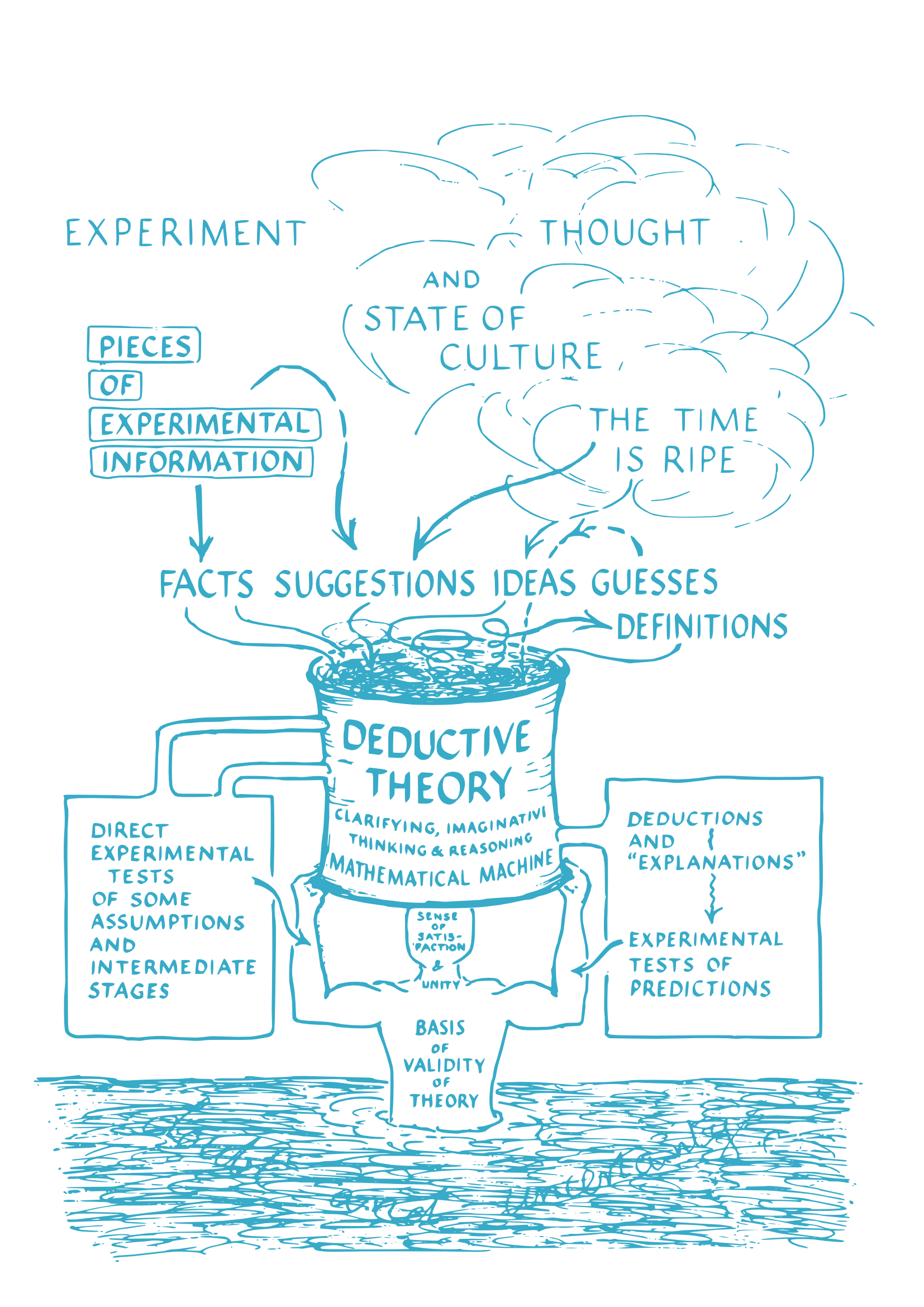
The working of a deductive theory in science. Image from Physics for the Inquiring Mind by Eric Rogers. Though many philosophers of science would disagree with this view, one can surely start with this.
“We want to show the world that we are innovators. We want to show the world that cloud storage has a right to exist. And, of course, when you launch something like this, you can expect some controversy. The content industry is going to react really emotionally about this. The US government will probably try and destroy the new business … you’ve got to stand up against that, and fight that, and I’m doing that … I will not allow them to chill me.”
Make no mistake, Aaron was a criminal and, despite popular belief, there was no prosecutorial overreach. The US Attorney who oversaw his prosecution described her office’s actions as “appropriate” and, according to the law, she was telling the truth. The job of prosecutors is to bully and intimidate suspects, using the threat of some of the world’s harshest sentencing laws into plea bargaining for a shorter sentence in exchange for an admission of guilt. This is American “justice;” our current system of severe sentencing and mandatory minimums gives prosecutors overwhelming power – power that was once in the hands of judges and juries – to the point that today less than 5% of criminal cases are resolved by a jury (3% in federal cases).
(This article was written for a college magazine.)
We have a vision for a better society in which the values of sharing and collaborating knowledge and technical know-how form an integral part. There are two aspects to this issue. One is why it should be done, and given the current social structure how it can be done. Though the why question is as important as the how one in this article we will try to focus more on how it can be done with aid of proper technology and what are the possible implications of this intervention to the citizens of the future.
The current education system does little to promote and impart the ideas of sharing knowledge with peers to the students who will be the future citizens. In our educational system it is more like each-one-for-oneself; if you help your peers you will be at a loss in the future. Another aspect is that the educational system by its nature is consumerist. By consumerist we mean that the schools system treat the students more like consumers, who are then passively fed in what has already been produced by others. There is no or little scope left for students to produce or construct anything meaningful. So the platform/technology which will address these issues should have the following qualities:
It should allow for collaboration / sharing of knowledge.
It should allow for active, meaningful and collaborative production / construction contexts, through which students will learn.
It should give immediate feedback to the student, not the delayed one (year end) which the current school system has. This is essential as it makes children reflective about the work that they are doing.
Learning in the context of constructing some tangible thing is a philosophy of education proposed by Seymour Papert, called constructionism. Constructionist learning is inspired by the constructivist theory that individual learners construct mental models to understand the world around them. However, constructionism holds that learning can happen most effectively when people are also active in making tangible objects in the real world. A closely related term that you might have heard is that of constructivism, but there are differences though.
The potential for transforming classrooms in a revolutionary way is present in the constructionist way of learning, which the existing CBTs (computer based tutorials) do not challenge but reinforce. The advances in technology have made it possible now to implement constructionist ways of learning to masses. So where are the examples of this?
The Sugar learning platform is just one such example which is specifically developed keeping in mind the above considerations. But the idea of constructionist learning is not limited only to using computers. displayed. The very idea of the platform is centered around the idea of constructionism. Though initially developed for OLPC (One Laptop Per Child) Project, now it can run on almost all computers. Learning in an environment where sharing knowledge is an inherent principle rather than an added externality provides the students with a whole new way of learning. Each activity on Sugar is designed keeping in mind the collaborative, construction context and immediate feedback principles.
The Sugar platform provides construction contexts from different areas to learn collaboratively like language, mathematics, science, drawing, music, games, programming, photography, audio and video recording among other things. For each of this activity can be done collaboratively by the students and can be shared with others. This also provides students to make meaningful connections between different concepts. In this context we have seen a strong urge in the children to share the knowledge and activities that they have with others, but in the current school system there is no or little provision for this. Sharing of activities provides context for feedback from peers, which in turn is fruitful in improving learning. Thus we see that the tools and time is ripe for changing our perspective towards education for a more inclusive and better society, whose core values are sharing of knowledge and collaboration.
There are pilot projects of Sugar running at many places across India, one is the Khairat Project which is running successfully for past 4 years at a primary tribal school of first generation learners near Mumbai, another one is at Merces School near Panaji in state of Goa.
It is convenient to set out s. 292 of the Indian Penal Code at this stage:
“292. Sale of obscene books etc. : Whoever- (a) sells, lets to hire, distributes, publicly exhibits or in any manner puts into circulation, or for purposes of sale, hire, distribution, public exhibition or circulation, makes, produces or has in his possession any obscene book, pamphlet, paper, drawing, painting, representation or figure or any other obscene object whatsoever, or
(b) imports, exports or conveys any obscene object for any of the purposes aforesaid, or knowing or having reason to believe that such object will be sold, let to hire, distributed or publicly exhibited or in any manner put into circulation, or
(c) takes part in or receives profits from any business in the course of which he knows or has reason to believe that any such obscene objects are, for any of the purposes aforesaid, made, produced, purchased, kept, imported, exported, conveyed, publicly exhibited or in any manner put into circulation, or
(d) advertises or makes known by any means whatsoever that any person is engaged or is ready to engage in any act which is an offence under this section, or that any such obscene object can be procured from or through any person, or
(e) offers or attempts to do any act which is an offence -under this section,
19(1) All citizens shall have the right-
(a) to freedom of speech and expression; (2) Nothing -in sub-clause (a) of clause (1) shall affect the operation of any existing law, or prevent the State from making any law, in so far as such law imposes reasonable restrictions on the exercise of the right conferred by the said sub-clause in the interests of public order, decency or morality”
No doubt this article guarantees complete freedom of speech and expression but it also makes an exception in favour of existing laws which impose restrictions on the exercise of the right in the interests of public decency or morality.
Condemnation of obscenity depends as much upon the mores of the people as upon the individual. It is always a question of degree or as the lawyers are accustomed to say, of where the line is to be drawn. It is, however, clear that obscenity by itself has extremely “poor value in the-propagation of ideas, opinions and informations of public interest or profit.” When there is propagation of ideas, opinions and informations of public interest or profit, the approach to the problem may become different because then the interest of society may tilt the scales in favour of free speech and expression. It is thus that books on medical science with intimate illustrations and photographs, though in a sense immodest, are not considered to be obscene but the same illustrations and photographs collected in book form without the medical text would certainly be considered to be obscene.
“I think the test of obscenity is this, whether the tendency of the matter charged as obscenity is to deperave and corrupt those whose minds are open to such immoral influences, and into whose hands a publication of this sort may fall. . . . . it is quite certain that it would suggest to the minds of the young of either sex, or even to persons of more advanced years, thoughts of a most impure and libidinous character.”
He wants us to say that a book is not necessarily obscene because there is a word here or a word there, or a passage here and a passage there which may be offensive to particularly sensitive persons. He says that the overall effect of the book should be the test and secondly, that the book should only be condemned if it has no redeeming merit at all, for then it is “dirt for dirt’s sake”, or as Mr. Justice Frankfurter put it in his inimitable way “dirt for money’s sake.
We need not attempt to bowdlerize all literature and thus rob speech and expression of freedom. A balance should be maintained between freedom of speech and expression and public decency and morality but when the latter is substantially transgressed the former must give way.
The taboo on sex in art and literature which was more strict thirty-five years ago, seemed to him to corrode domestic and social life and his definite view was that a candid discussion of sex through art was the only catharsis for purifying and relieving the congested emotion is.
“The law seeks to protect not those who protect themselves, but those whose prurient minds take delight and sexual pleasures from erotic writings.”
The word “obscene” in the section is not limited to writings, pictures etc. intended to arouse sexual desire. At the same time the mere treating with sex and nudity in art and literature is not per se evidence of obscenity.
Exception. – This section does not extend to any book, pamphlet, writing, drawing or painting kept or used bona fide for religious purposes or any representation sculptured, engraved, painted or otherwise represented on or in any temple, or on any car used for the conveyance of idols, or kept or used for any religious purpose.”
This was I think long back, but the views have not changed ever since the. The idea that somethings are bad for everyone is something which all cultures adhere to, and it is very hard for people, especially people in power to let this notion go. This is another way of controlling people. This is what is common to fundamentalism and democracy. The notion that our past was a golden one, and anything new will harm it and jeopardize the future of the culture. From what I feel is that there was no golden past, it just was.
And thinking about morality, though they say that there are some universal principles, everyone does not subscribe to same ones. In his theory Kohlberg, outlines these differences. But that said, he does not talk about obscenity, which I think it is highly cultural. For example a burqa clad woman is a common picture in certain Islamic communities, or a woman with ghunghat is all but common in certain Hindu communities, but at the same time some people might be find it too restrictive. And a woman in short skirt might be a common scene in the urban areas in certain countries, but it might be a great taboo for some others. There are no universal standards for what counts as moral or decent.
Recently I had to make and print a lot of certificates, each with different names and affiliations. There are programs in the Office environment which do this. They are called as Mail Merge, primarily being used for sending mass mails to many individuals.
Basically following happens:
You have a database of Names / Addresses and Affiliations with you. Lets say there are 500 names in this database. If you want to make certificates for everyone of them, it is not very bright to manually add every name to the certificates. What the program does is takes this list of names, and inserts it into a template and generates a file for each entry in the database. Which is to be printed.
I had designed a certificate for one of the programs using a Free Software SVG Editor Inkscape, initially the number of entries was not large, but then they became too much for me to manage manually.
So then there is small plugin called the Inkscape Generator that came to help me big time.
This is something that I had been exactly looking for.
As explained on the page for the plugin the database has to be in a csv format, which can be conveniently generated and edited in any of the spreadsheet programs like Calc for Libre Office. With this it becomes super-easy to generate pdf’s for each of the entries in the database.
Once all the pdf’s have been generated using pdftk one can simple join all the files in a single pdf file and print at one go.
To join:
Recently there was a news item in Times of India which had the same heading as that of this particular post. The news claimed
(Around two decades back Dada Dham, a socio-spiritual organization brought together a team of botanists, ayurvedic scholars and environmental enthusiasts to study the environmental benefits of tulsi.)
NAGPUR: Ayurvedic medicinal values of Tulsi are well known. Our ancient scriptures have enumerated the medicinal benefits of tulsi. Its extracts are used widely for curing common ailments like common cold, headache, stomach disorder etc.
But the environmental benefits have been comparatively unknown. Around two decades back Dada Dham, a socio-spiritual organization brought together a team of botanists, ayurvedic scholars and environmental enthusiasts to study the environmental benefits of tulsi.
Now the next claim from an “eminent botanist” that the report does is startling indeed.
“Tulsi gives out oxygen for 20 hours and ozone for four hours a day along with the formation of nascent oxygen which absorbs harmful gases like carbon monoxide, carbon dioxide and sulphur dioxide from the environment,” said Shyamkant Padoley, an eminent botanist.
How would the tulsi plant (Ocimum tenuiflorum) do this? Is it anatomically so different that it is capable to do this? How does the plant regulate this 20 and 4 hour cycle? I would really like to know. How is that no other plants have this cycle? How did they detect presence of ozone, what detectors they used? What mechanisms in presently known cycle of photosynthesis account for this cycle? And if this is part of the standard photosynthesis process, then all plants should have it. This seems fishy, and a most preliminary search did not yield any positive result. All of them talk about production of oxygen and not ozone, as reported by Padoley. And if this is indeed true, it might lead to change in our conception of the photosynthetic cycle.
And if the ozone report is to be believed at all then this is what ozone does to you quote from Wikipedia article on ozone:
Ozone is a powerful oxidant (far more so than dioxygen) and has many industrial and consumer applications related to oxidation. This same high oxidizing potential, however, causes ozone to damage mucus and respiratory tissues in animals, and also tissues in plants, above concentrations of about 100 parts per billion. This makes ozone a potent respiratory hazard and pollutant near ground level.
…
There is evidence of significant reduction in agricultural yields because of increased ground-level ozone and pollution which interferes with photosynthesis and stunts overall growth of some plant species. The United States Environmental Protection Agency is proposing a secondary regulation to reduce crop damage, in addition to the primary regulation designed for the protection of human health.
…
There is a great deal of evidence to show that ground level ozone can harm lung function and irritate the respiratory system.Exposure to ozone and the pollutants that produce it is linked to premature death, asthma, bronchitis, heart attack, and other cardiopulmonary problems.
…
Ozone is air pollutant, green house gas.
To summarize this is that ozone is NOT GOODfor us at ground level! It may do us good in upper atmosphere to block UV Rays, but down here on ground it is bad. And if this claim of ozone production by Tulsi is true why is the campaign of “Tulsi lagao pradushan hatoa (Plant tulsi, remove pollution)” which follows in the article is being implemented?
Padoley, member of technical committee, ministry of environment and forest, NewDelhi, and forest tech committee, also read a paper at the International Conference on Occupational Respiratory Diseases at Kyoto in 1997 where cyclo oxygenate, an enzyme only found in tulsi was labelled for the first time. This enzyme regulates the entire mechanism of oxygen evolution. (emphasis added)
This again I am unable to understand. It says this enzyme is “only found in Tulsi”, and it also “regulates entire mechanism of oxygen evolution”. One can agree that a particular enzyme is found in a particular plant, but if this enzyme controls “entire mechanism of oxygen evolution”, how do other plants regulate their mechanisms of oxygen evolution.
Dada Dham initiated a campaign ‘Tulsi Lagao Pradushan Hatao’ in 1987 under the guidance of Narendra Dada, the institution’s head. It was under this campaign that the above mentioned panel of experts was formed. After finding out the environmental benefits of the plant, Dada Dham organized a number of programmes like street plays, nukkad sabhas and lectures to propagate the use of the plant.
Dr Dattatraya Saraf, an ayurvedic doctor and expert said, “The plant enriches the environment with oxygen almost 24X7 and also absorbs other pollutants.” He further added that if the size of the plant can be increased, the environmental benefits can be increased.
This statement that “plant enriches the environment with oxygen almost 24X7” is in contradiction to statement by above Padoley regarding 20 and 4 hour cycles. Which one is to be believed? And mind you this is just appearing a few lines later, this is either very poor editing and reporting, or hogwash to the public.
“That is why we want to urge scientists and concerned authorities to make research on the issue of increasing the height of tulsi plant. If big trees can be converted to bonsai plants then big tulsi trees can be possible too,” said Kishor Verma, PRO of Dada Dham.
This is another statement that I would like to contest. Did they compare the rate of oxygen production vis-a-vis to other plants. That is to say simply did they have any control sample? And does making “tulsi tree” make any sense (can one really do it is another question), will it really increase oxygen making capabilities, is it a linear relationship between these two variables? The water is completely muddy in this !
He also citied the research and work by other organization in support of tulsi’s environmental benefits.
“The forest department of Uttar Pradesh, with the help of an organization called Organic India Limited, Lucknow planted lakhs of tulsi saplings around Taj Mahal to protect its surface from industrial emissions. This step has yielded positive results,” Verma said.
“We are just asking the administration to take notice of these extra ordinary benefits of tulsi and take steps for utilizing them. Even simple steps like planting tulsi plants on road dividers, parks etc can bring a difference,” said Verma.
The reporter and also the editor make no effort to correct these glaring inconsistencies in the report itself, forget about doing nay research on the topic, or verifying the claims made by these people. Maybe this was like the paid news that is talked about a lot these days.
What I find here i that the agenda of what is to be done was already set, the conclusions were already drawn, by our ancestors, written in black and white in ancient texts. The point was only to justify what they were doing, and trying to provide a “scientific basis” of what they already believed to be true (for whatever reasons, mostly religious, and presence of a religious organization in this sort of confirms this).
A good example of pseudo-science and bad science reporting.





“Tulsi gives out oxygen for 20 hours and ozone for four hours a day along with the formation of nascent oxygen which absorbs harmful gases like carbon monoxide, carbon dioxide and sulphur dioxide from the environment,” said Shyamkant Padoley, an eminent botanist.